
In U.S. churches, pastors are generally highly esteemed, and in some places almost idolized by their congregations. Therefore, to question pastoral actions or lack thereof, teachings, or approaches to ministry can be frowned upon. Those who make waves may ride them right out the front door! Many parishioners experience church like ducks swimming serenely on a pond. The only disturbances are beneath the surface, known only by leadership and staff. In fact, many churches I’ve attended make a mantra of Ephesians 4:3: “Make every effort to keep the unity of the Spirit through the bond of peace.” Unity is assumed to mean compliance with the status quo and peace is the absence of all conflict.
How does your church deal with concerns regarding a pastor or other spiritual leader? Are you expected to go directly to the pastor or other leaders with your concerns? What happens after that? Is the congregation ever involved? Are you reluctant to share your concerns publicly for fear of damaging the church or pastor’s reputation? Do you fear harming unbelievers with the truth of a hurtful situation? These are weighty considerations indeed.
As I reflected upon several hurtful encounters with leaders recently, I began to ask myself how Jesus interacted with his religious leaders? After all, he was a Jew, attended synagogue (the equivalent of attending church for Christians), and as such was under the “spiritual authority” of its leaders. Did he promote unity and peace above other virtues as is often practiced in churches today? I spent two days reading the Gospels and looking at every encounter Jesus had with religious leaders. I counted 35 separate exchanges. Here are some of Jesus’s responses that I noted:
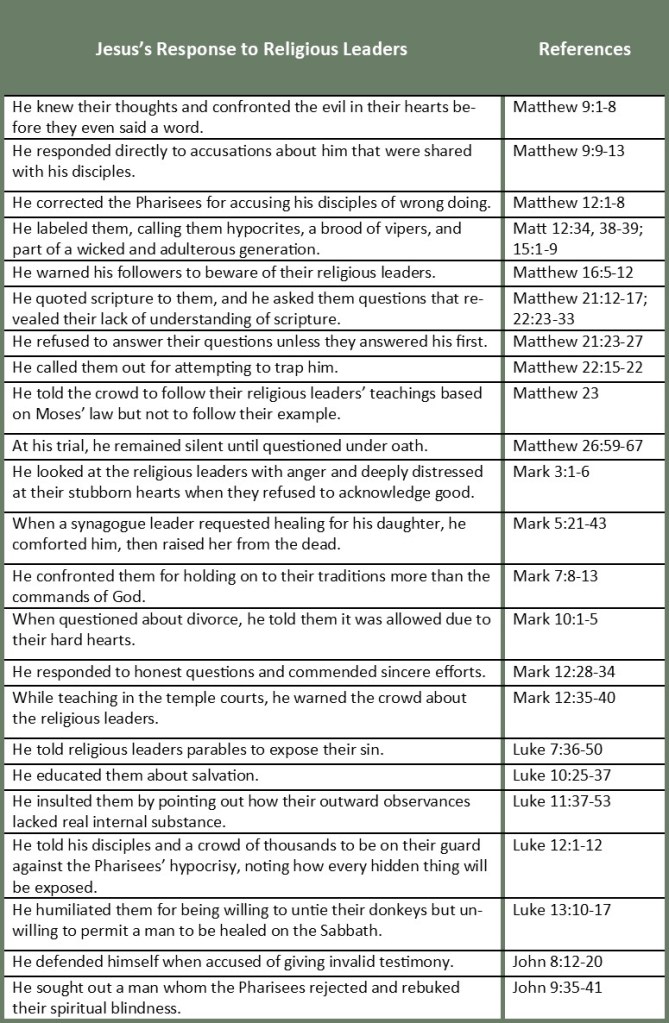
I don’t see Jesus focused on protecting the religious leader’s reputations or reluctant to expose their evil actions to others, do you? Rather he confronts evil directly, not dancing around it in the name of peace and unity. He defends the weak and seeks out the lost. Not once did he ignore the leaders’ sin in order to avoid conflict or maintain an appearance of unity. He cared too much to pretend all was well. In correcting and admonishing these leaders, Jesus was actually loving them.
Of course, some may say since he was the Son of God, he had the insight and authority to confront in ways that everyday Christians do not. Well, let’s look at that more closely in the light of a scripture that many abusive leaders love to quote—Matthew 18:15-17:
“If your brother or sister sins, go and point out their fault just between the two of you. If they listen to you, you have won them over. But if they will not listen, take one or two others along, so that every matter may be established by the testimony of two or three witnesses. If they still refuse to listen, tell it to the church, and if they refuse to listen even to the church, treat them as you would a pagan or a tax collector.”
In my experience, this usually plays out in churches with parishioners believing they must first go to their pastor about their concerns, and then include other leaders if necessary. But I have yet to see the last part of this scripture, “tell it to the church,” practiced, especially if spiritual leaders are at fault. Usually, the concerned or wounded person leaves before that happens because they have already suffered so much behind closed doors, including being warned not to gossip or to present a negative witness to onlookers. The reality is that Jesus didn’t hesitate to warn onlookers about the evil behavior of religious leaders in his day!
Now here’s another scripture that is rarely quoted except to encourage parishioners to honor their pastors—I Timothy 5:17-21:
“The elders who direct the affairs of the church well are worthy of double honor, especially those whose work is preaching and teaching. For Scripture says, ‘Do not muzzle an ox while it is treading the grain,’ and, ‘The worker deserves his wages.
Do not entertain an accusation against an elder unless it is brought by two or three witnesses. But those elders who are sinning, you are to reprove before everyone, so that the others may take warning. I charge you in the sight of God and Christ Jesus, and the elect angels to keep these instructions without partiality, and to do nothing out of favoritism.”
First, it’s elders (or spiritual leaders) who direct the affairs of the church well who are worthy of double honor, not anyone who holds the office of pastor based solely on their credentials or job title. Many leaders are worthy of honor as they love God and care for his people, but some do not carry out their responsibilities well.
Secondly, notice that those elders who sin are to be reproved openly, before everyone, as a warning to others. How often have you seen that happen in church? How often instead have two or more witnesses quietly left a church because of a leader’s actions? Why is no one paying attention to this charge in the scriptures? If you observe people leaving, wisdom mandates seeking them out and asking them honestly why they are no longer there.
I believe if we did, there would be a lot less spiritual abuse in churches, and a lot more parishioners, who had been mistreated and driven away, could be restored. Whereas Christians today tend to put spiritual leaders on pedestals, Jesus encouraged us to treat one another equally as brothers and sisters. (See Matthew 23:7-11). True unity and peace are reflections of the heart not of a culture of silence. Maybe it’s time to begin focusing on speaking the truth in love again to our spiritual leaders and to one another. Maybe it’s even time to “make waves” in some churches or to “flip a few tables” in Jesus’ name! What do you think?
 Restored Destiny
Well written and thought provoking. If making waves is what it takes to resolve a problem or misunderstanding, do it.
LikeLike